
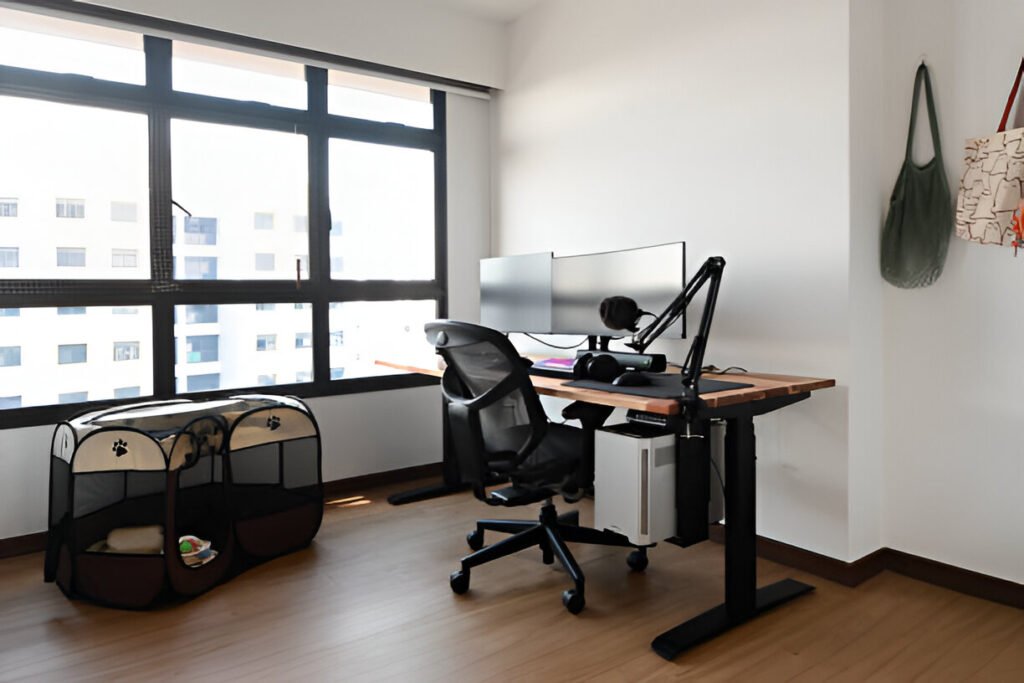
Working from a small space doesn’t have to mean dealing with a cramped, cluttered mess. With the right 10 x 10 home office layout, a 100-square-foot room can transform into a productive, comfortable workspace. Smart furniture placement, strategic storage, and thoughtful zoning allow remote workers to maximize every inch, proving that small spaces can be highly effective.
The key to a functional 10 x 10 home office layout isn’t simply buying smaller furniture or tucking your desk into a corner. It’s about using the space strategically so the room feels open, organized, and conducive to work rather than cramped and chaotic.
Key Takeaways:
- Proper desk placement creates visual flow and maximizes usable floor space
- Vertical storage solutions prevent clutter without eating into your footprint
- Light colors and strategic furniture choices make 10 x 10 rooms feel larger
- Ergonomic spacing prevents physical strain even in tight quarters
- Smart cable management and wireless tech reduce visual chaos
What Are the Challenges of a 10 x 10 Home Office?
What Space Constraints Do 10 x 10 Offices Face?
A 10 x 10 office gives you 100 square feet to fit everything: desk, chair, storage, and maybe a guest seat if you’re optimistic. That’s roughly the size of a large walk-in closet.
You’re working with a limited floor area, so every piece of furniture needs to earn its place. Storage becomes an immediate challenge because file cabinets and bookshelves consume valuable square footage.
Common constraints include:
- Separating work from relaxation zones is practically impossible when your entire office fits in a corner of a bedroom
- Door swings take up space you hadn’t accounted for
- Windows might be perfectly placed for light, but they’re poor for desk positioning due to glare
- Limited floor area forces every furniture piece to justify its presence
- Storage solutions compete directly with workspace for square footage
How Do 10 x 10 Offices Impact Productivity and Comfort?
Cluttered spaces mess with your ability to focus. When papers pile up because there’s nowhere to file them, or cables snake across your desk because you don’t have room for proper management, your brain gets distracted.
Poor ergonomics can be more pronounced in small rooms. You might skimp on chair clearance or cram your desk too close to the wall, and suddenly you’re dealing with neck pain after a few hours.
The psychological weight of a cramped environment is real. Studies from organizations like Steelcase show that confined spaces without proper light or breathing room can tank your mood and productivity fast.
Cultural factors also play a role. According to CCOHS ergonomic research, North Americans and northern Europeans need more personal space to feel comfortable than people from denser populations.
How Do You Plan a 10 x 10 Home Office Layout?
How Do You Measure and Map a 10 x 10 Office?
Grab a tape measure and map out your exact dimensions before buying anything.
Start by measuring wall-to-wall in both directions. Don’t assume it’s exactly 10 x 10 because construction isn’t always precise. Next, mark where doors open and where windows sit.
Create a scaled floor plan on paper or use a free room planner app. This saves you from ordering a desk that physically won’t fit through your door or blocks your only window.
Identify where natural light enters the room, and position your primary workspace to maximise it without causing screen glare.
How Do You Create Zones in a 10 x 10 Office?
Even in 100 square feet, you can carve out distinct zones. Your work zone should include a desk, a chair, and approximately 6 feet by 4 feet of clear circulation space, per ergonomic guidelines.
That’s your command center where focus happens. The storage zone lives vertically. Consider wall-mounted shelves above your desk or tall bookcases that draw the eye upward rather than consuming floor space.
If you’ve got room left, a small reading corner with a compact chair gives your brain somewhere to shift during breaks.
What Are the Minimum Clearances Needed in a 10 x 10 Office?
Pathways need 30 to 36 inches of clear width so you’re not doing awkward side shuffles every time you move.
This isn’t optional. It’s about preventing trips and maintaining basic mobility. Measure from your chair’s farthest-back position to the nearest wall or piece of furniture behind you.
How Should You Place Your Desk and Chair in a 10 x 10 Office?
What Is the Optimal Desk Position in a 10 x 10 Office?
Facing your desk toward a window provides natural light and a view, which research under the WELL standards confirms boosts well-being.
Just watch out for screen glare. You might need blinds or sheer curtains. Placing your desk against a wall maximizes open floor space in the center, making the room feel less cramped.
Corner placement works too if you’re using an L-shaped desk, keeping the room’s middle clear for movement. Think about visual flow. When you walk in, does the layout feel intentional or chaotic?
How Much Space Does an Ergonomic Chair Need?
Your chair needs 24 to 30 inches of clearance behind the desk so you can push back without hitting a wall.
According to OSHA guidelines, your monitor should be at least 20 inches from your eyes, which requires adequate desk depth.
Chair types matter in tight quarters. Skip the massive executive chairs with wide armrests that bump into everything.
Instead, look for compact, ergonomic chairs under 24 inches wide that provide proper lumbar support without dominating the room.
What Are the Chair Clearance Requirements for a 10 x 10 Office?
Measure from the back edge of your desk to the wall behind you. If you have less than 24 inches, you’ll feel cramped.
Thirty inches is preferable because it provides room to stand up smoothly and shift during long work sessions without constantly bumping into objects.
What Are the Best Storage Solutions for a 10 x 10 Office?
What Vertical Storage Options Work in a 10 x 10 Office?
- Wall-mounted shelves free up floor space. Install them 12 to 14 inches above your desk to keep supplies within arm’s reach without blocking your monitor.
- Tall bookcases that reach toward the ceiling create the illusion of greater height, making rooms feel more spacious than they are.
- Pegboards mounted on walls let you hang accessories, headphones, and supplies vertically. Everything stays visible and accessible without cluttering your desktop.
- Wall hooks screwed into studs extend your storage capacity by holding bags, jackets, or cable organizers off the floor.
- Floating corner shelves use dead space that otherwise goes to waste in room layouts.
What Multi-Functional Furniture Works in a 10 x 10 Office?
- Desks with built-in drawers provide storage without adding separate file cabinets that consume floor space.
- Foldable tables let you collapse extra workspace when you don’t need it, then expand for projects that require spreading out.
- Storage ottomans double as guest seating and offer hidden compartments for office supplies you use infrequently but keep nearby.
- L-shaped desks provide more surface area while fitting neatly into corners, keeping the room’s center open for movement and making the space feel less confined.
How Do You Declutter a 10 x 10 Home Office?
Keep only what you actually use in your office, and relocate everything else to your basement, a closet, or elsewhere, not in your 100-square-foot workspace.
Digital storage outperforms physical storage for most documents these days, reducing the filing cabinets and paper boxes that accumulate.
Set up a monthly routine to purge accumulated papers, cables, and supplies that no longer serve any real purpose.
This consistent reduction creates more breathing room, which directly impacts how spacious the office feels.
How Do Lighting and Color Make a 10 x 10 Office Feel Larger?
What Lighting Setup Works Best in a 10 x 10 Office?
Maximize sunlight by positioning your desk near windows, but angle your monitor 90 degrees to the glazing to avoid glare.
For artificial lighting, layer it. Use ambient ceiling fixtures for general illumination at approximately 200 lux, plus task lighting at 300 to 500 lux at your desktop.
Adjustable desk lamps positioned opposite your writing hand prevent annoying shadows.
Dark corners make small rooms feel even smaller, so add accent lighting to wash walls and create depth.
What Colors Make a 10 x 10 Office Appear Larger?
Light walls reflect more light and visually expand space. White, off-white, and soft neutrals work well.
Because single overhead lights create harsh contrasts that emphasize the room’s limited size, this layered approach becomes especially important.
Research on color psychology shows that muted cool tones like soft blue-grey or desaturated green support sustained focus while making rooms feel airier.
Once you’ve established these quiet base tones, warm accents in terracotta or ochre add personality without overwhelming the space.
Keep large surfaces quiet and introduce color through smaller verticals. Think shelf backs, artwork, or a single accent curtain.
Coordinating furniture colors with wall tones creates visual continuity that tricks the eye into perceiving more space.
How Do You Select Furniture for a 10 x 10 Office?
What Size Desk and Chair Fit a 10 x 10 Office?
Desks between 48 and 60 inches wide fit comfortably in most 10 x 10 layouts without crowding.
Depth is also critical: 24 inches provides room for a monitor and keyboard while leaving enough workspace without pushing you too far from the wall.
Adjustable-height desks let you alternate between sitting and standing, freeing up floor space when you’re upright.
Chairs with minimal footprints and no bulky armrests maneuver better in tight spaces while still supporting your back.
What Shelving Works in a 10 x 10 Office?
- Floating shelves create storage without visible brackets or supports that add bulk.
- Modular shelving units adapt to your changing needs. Add or remove sections as your storage requirements shift.
- Stackable storage bins keep supplies organized and easy to relocate if you rearrange furniture later.
What Multi-Purpose Furniture Should You Add to a 10 x 10 Office?
- Foldable partitions can visually separate your work zone from the rest of a shared room without permanent walls.
- Convertible furniture, like wall-mounted desks that fold up when not in use, transforms your office into a multipurpose space for occasional tasks or guest needs.
What Are the Best Layout Options for a 10 x 10 Office?
Linear Layout
This straightforward approach puts your desk along one wall with storage directly opposite. Your chair faces the room, giving you a clear view of the door and windows.
Storage units line the facing wall at varying heights. A low credenza holds frequently accessed items, and taller shelves above accommodate books and decor.
Pros:
- Simple to implement with standard rectangular furniture
- Clear separation between work and storage zones
- Easy traffic flow with center pathway open
Cons:
- Limited workspace surface area compared to L-shaped options
- Can feel rigid without creative furniture choices
- Storage accessibility requires turning away from the desk
L-Shaped Layout
Place an L-shaped desk in one corner to maximize work surface while keeping the room’s center open. One leg of the L holds your computer setup.
The other provides space for writing, projects, or spreading out documents. Storage fits along adjacent walls where you can reach it with a simple swivel.
Pros:
- Generous workspace without blocking room flow
- Natural division between different task types
- Corners utilized efficiently
Cons:
- Requires specific desk configuration
- Cable management gets trickier with corner placement
- Less wall space available for other furniture
U-Shaped Layout
When your space allows and you need maximum work surface, a U-shaped configuration surrounds you with a desk on three sides.
This works by connecting two desks along perpendicular walls with a middle extension using filing cabinets or small tables. You’re positioned in the center with everything within arm’s reach.
Advantages:
- Massive workspace for multi-monitor setups or projects
- Storage and workflow are completely integrated
- Professional appearance for video calls
Considerations:
- Takes up significant floor space in a 10 x 10 room
- Limits guest seating options
- Requires careful planning to avoid a trapped feeling
How Do You Make a 10 x 10 Office Feel Larger?
Strategically placed mirrors reflect light and create an illusion of depth. Mount one opposite your window to bounce natural light around the room.
Floating furniture, like desks with legs instead of solid bases and wall-mounted shelves, opens visual sightlines to the floor.
This unobstructed, wall-to-wall view makes the room feel less cluttered and helps you perceive the full dimensions of your space.
Rugs define work zones without physical barriers, using color or texture to separate your desk area from a reading nook visually.
How Do You Set Up Technology in a 10 x 10 Office?
Cable management prevents visual chaos that makes small spaces feel cramped. Here’s how to handle it:
- Mount power strips underneath your desk using Velcro, then bundle cables with reusable ties to keep them organized and accessible.
- Hidden wires create cleaner sightlines.
- Wireless peripherals like keyboards, mice, and printers eliminate cables snaking across your desktop.
- Compact monitors with thin bezels take up less visual space than bulky older models.
- USB hubs consolidate connections into a single port, eliminating the need for multiple cables.
By eliminating physical clutter and visual noise simultaneously, these wireless and consolidated solutions reduce chaos without sacrificing functionality.
How Do You Maintain a 10 x 10 Home Office?
- Daily habits prevent accumulation. Spend five minutes at day’s end returning supplies to designated spots and clearing your desktop.
- Weekly reviews catch creeping clutter before it becomes overwhelming.
- Seasonal decluttering every three months gives you a chance to reassess what’s actually earning its place in your limited space.
Adjust your layout as work needs evolve. Maybe you need more surface area for a new project, or you can ditch a filing cabinet after going digital.
Summary and Action Plan
Strategic layouts transform 10 x 10 rooms from cramped corners into legitimate workspaces. Desk placement that considers light and ergonomics sets your foundation.
Vertical storage pulls clutter off floors, while light colors and smart furniture choices visually expand the space. Proper spacing reduces physical strain, even in tight spaces.
Cable management and wireless technology reduce visual noise, making small rooms feel less chaotic.
Implementation Checklist:
- Measure your space accurately and create a scaled floor plan
- Select a desk 48-60 inches wide and 24 inches deep minimum
- Ensure 24-30 inches of chair clearance behind your desk
- Install vertical storage 12-14 inches above the workspace
- Position the desk to maximize natural light without screen glare
- Maintain 30-36 inch pathways for safe movement
- Choose light wall colors and coordinating furniture tones
- Implement wireless peripherals where possible
- Set up an under-desk cable management system
- Establish daily and seasonal organization routines
Experiment with different layouts before committing. Move furniture around and live with each configuration for a few days, because small spaces demand personalization based on how you actually work, not just design theory.
What looks perfect on paper might not feel right in practice, and discovering that through trial and error allows you to create a setup that truly fits your workflow.
FAQ On 10 x 10 Home Office Layout
How to arrange a 10×10 office?
Start by placing your desk near windows for natural light, maintaining 24-30 inches of clearance behind your chair.
Use vertical storage on walls to keep floors clear, and choose furniture between 48-60 inches wide that fits the space without overwhelming it.
What is a good size for a home office?
Most solo workers need at least 70 to 100 square feet for comfortable computer-based work.
A 10 x 10 room at 100 square feet falls at the upper end of compact office sizes, providing enough space for a functional setup with smart furniture choices.
Is a 10×10 office big enough?
Yes, absolutely. With proper planning, 100 square feet accommodates a full desk setup, an ergonomic chair, adequate storage, and comfortable movement space.
The key is maximizing vertical storage and choosing appropriately sized furniture rather than cramming oversized pieces into the room.
Is a 10×10 living room too small?
While a 10 x 10 living room is compact, it’s a different question than office sizing. Living rooms need space for multiple people and furniture pieces, whereas offices prioritize individual workspace efficiency. For an office, a 10 x 10 layout works well with thoughtful design choices.