
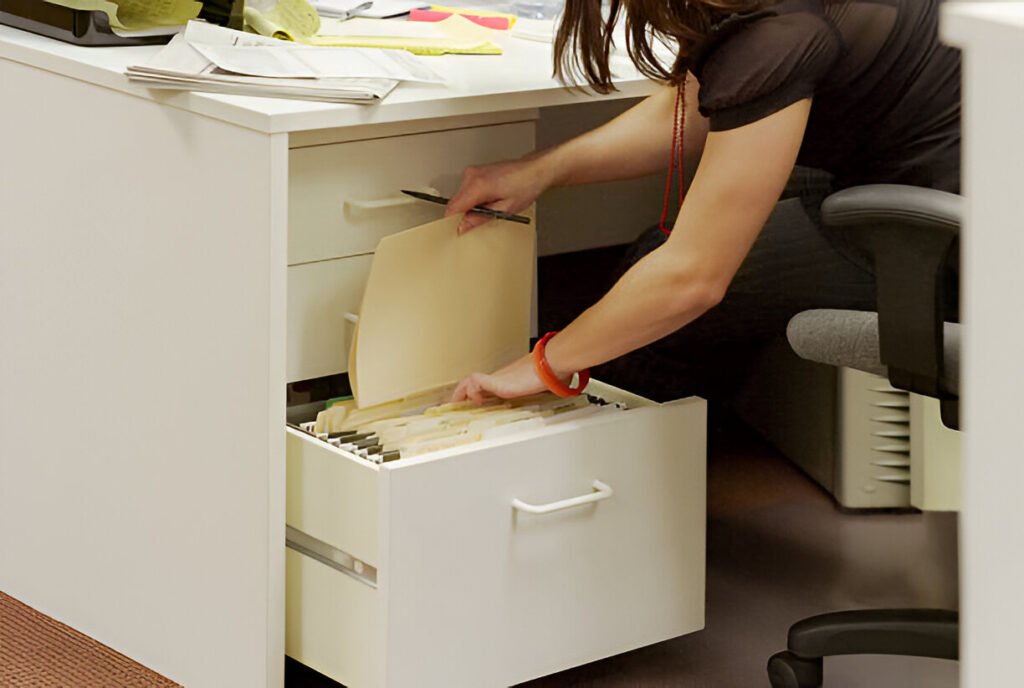
Remote work changed everything. I’ve been working from home since before it was a thing, and paper clutter still happens despite digitization.
Tax documents, contracts, manuals, and client files need physical storage. Home office storage will hit $12.05 billion in 2025, growing at 4.78% annually through 2030.
Most of us work from bedrooms, converted closets, or shared spaces. You can’t just slap a massive filing cabinet in the corner.
Space is tight, budgets are tighter, and you need functional solutions, so this post covers the best file cabinets for home office organization and saving space.
Quick Takeaways:
- Vertical saves floor space but lateral holds 30% more per drawer
- Mobile under-desk works for spaces under 100 square feet
- 15-16 inch width ideal for under-desk placement
- Metal outlasts wood 5-10 years but costs 40% more
- Leave 36 inches clearance for drawer swing
What Makes a File Cabinet “Best” for a Home Office
Given these space and budget constraints, cabinet selection is highly dependent on individual circumstances. What works in corporate offices with unlimited floor space won’t work when fighting for every inch in spare bedrooms.
Understanding which features matter for your particular setup determines whether a cabinet solves problems or creates new ones.
How Do File Cabinets Optimize Space and Footprint?
For most home offices, floor space becomes the primary constraint. Vertical cabinets typically measure 15-20 inches wide and extend 20-24 inches deep.
Lateral cabinets are 30-42 inches wide and 18-24 inches deep. Vertical cabinets are best when you have available wall space and need a narrow footprint.
Lateral designs maximize horizontal space and hold more per square foot. Corner-friendly designs with chamfered edges or slim profiles under 16 inches tuck into wasted spots.
Storage Capacity and File Compatibility
For most home-office documents, letter-size folders should suffice without compatibility issues. Legal-size documents, however, require either wider lateral drawers or longer vertical depth.
Given this compatibility difference, most home workers default to letter size unless they regularly handle legal documents. Check the adjustable rails, as quality cabinets can switch between formats without requiring new units.
Hanging file systems with full suspension keep folders upright and accessible.
RELATED: 11 Small Home Office Layout Ideas and Tips That Make Working From Home Actually Enjoyable
Build Quality, Durability, and Materials
Metal cabinets handle 50+ pounds per drawer without sagging, resist moisture, and last 15-20 years. Powder-coated finishes resist scratches. Wood blends well with home furniture but is heavier, more expensive, and more sensitive to humidity.
Beyond material type, steel thickness determines structural longevity. Cabinets made of 0.8mm or thicker cold-rolled steel provide the necessary structural integrity. Anything thinner flexes under load, gradually misaligning the drawer over months of use.
Security and Locking Mechanisms
Central locking secures all drawers with one key. In home offices, locks primarily serve privacy rather than theft prevention, keeping children, roommates, or guests away from sensitive documents. Decent locks add $30 but prove worth it for tax returns or client information.
What Are the Different Types of File Cabinets for Home Offices?
Vertical File Cabinets
Vertical cabinets stack drawers vertically, typically 50-60 inches tall for four drawers. Since files sit front-to-back in these units, accessing rear documents requires pulling drawers to full depth. This narrow profile makes them ideal for use beside desks or in tight spaces where width is the limiting factor.
The primary advantage is the ability to leverage unused vertical space. However, the top drawers on tall units require standing and reaching, which makes daily access impractical. Each drawer typically holds 400-600 sheets, depending on paper thickness, making them suitable for moderate-volume storage.
This capacity makes them perfect for archival storage, where you file quarterly and rarely retrieve documents. For constant document retrieval, lateral designs offer better access.
Lateral File Cabinets
Lateral cabinets orient files side-to-side. These wider drawers, measuring 30-42 inches, each accommodate 800-1000 sheets. This width allows viewing multiple file tabs simultaneously, eliminating the need to rummage through folders.
Despite appearing less space-efficient, laterals actually provide more filing capacity per square foot than verticals. Among lateral options, 42-inch models typically offer the best capacity-to-cost ratio. The lower profile also creates a flat top valuable surface for printers or other equipment in space-constrained setups.
Typically, two-drawer lateral cabinets are 30 inches tall, while vertical cabinets are taller. This lower profile provides easier reach and reduces tipping risk while visually anchoring the space without vertical dominance.
Mobile File Cabinets
Mobile cabinets sit on casters and roll anywhere needed. Most measure 15-18 inches wide and under 26 inches tall, allowing them to tuck beneath standard 28-30 inch desks. These typically feature two or three drawers: the bottom accommodates hanging files, and the upper drawers hold supplies.
The portability advantage comes at the cost of stability. Lighter construction, necessary for mobility, reduces tipping resistance.
At 35-50 pounds compared to 75-100 for stationary models, mobile cabinets lack the mass to counterbalance loaded drawers.
This lighter weight means that opening fully-loaded upper drawers can tip the entire unit forward.
Quality units address this with rear ballast weights or anti-tip interlocks that prevent multiple drawers from being opened simultaneously.
Stability Considerations and Weight Capacity
Weight capacity varies significantly across models. Budget models handle 20-30 pounds per drawer while commercial-grade units support 50+ pounds.
Check the specifications before storing heavy binders or equipment. Some manufacturers add fifth-wheel assemblies to help prevent tipping, though they create a bulkier appearance.
Lockable casters prevent unwanted rolling, which matters when leaning on cabinets during use.
Flat File Cabinets
Flat files store oversized documents horizontally in shallow drawers. Architects and designers use these for blueprints, posters, and portfolios up to 24″ x 36″ or larger. These represent specialized, expensive solutions that remain unnecessary unless regularly working with documents that won’t fold.
For the vast majority of home workers handling standard paperwork, flat files are not practical.
Multifunctional File Cabinets
Multifunctional designs combine filing with features such as deep drawers paired with shallow supply drawers. Some include reinforced tops for printers, while others integrate seating cushions, though these never provide comfort for extended sitting.
This combined approach works well in limited square footage, where a single unit must handle multiple needs. Just ensure the additional features don’t compromise core filing functionality.
Which File Cabinets Work Best in Small Home Offices and Apartments?
Ultra-Slim and Narrow File Cabinets
Slim profiles under 15 inches wide fit alongside desks without creating pinch points. These sacrifice capacity but work for tight layouts.
Typically limited to two drawers, they restrict long-term storage but work well for users who purge regularly.
Metal construction keeps slim cabinets rigid, where wood equivalents would flex under load.
Under-Desk File Cabinets
Under-desk placement requires precise measurements beyond cabinet dimensions alone.
Standard desks are 28-30 inches high, so cabinets must be under 24-26 inches tall to maintain adequate leg and chair clearance—three-drawer pedestals balance capacity and height within these constraints.
Width measurements are equally critical; 15-16 inches provide optimal sizing without compromising legroom.
Wider units push you away from the desk, ruining ergonomics. The standard 36-inch clearance rule still applies since drawers must fully extend without hitting chairs.
Vertical Storage Cabinets for Tight Spaces
Vertical cabinets shine when floor space is minimal. A 15-inch-wide unit takes barely more space than a wastebasket but provides four drawers running up the wall. Position these in corners or dead zones where floor area is otherwise wasted.
The height tradeoff becomes apparent with daily access patterns. Users under 5’6″ find that upper drawers require step stools. Frequent access to top drawers becomes tiring when it requires constant standing and reaching.
Wall-Adjacent and Corner-Friendly Options
Corner placement converts wasted space into functional storage. Some cabinets feature angled edges specifically for corner positioning.
Wall-adjacent placement requires measuring the full drawer extension and ensuring adequate clearance.
A 20-inch-deep drawer requires at least 24 inches of clearance, preferably 30 inches if you walk past the area regularly.
Space-saving features to consider:
- Caster wheels for repositioning
- Stackable units build vertical storage
- Modular side-by-side expansion
- Reversible drawer configurations
- Flush handles prevent snags
Which File Cabinet Should You Choose Based on Your Work Type?
For Remote Workers
Daily access patterns mean quick-reach placement matters significantly. Mobile pedestals under your desk keep essential files within arm’s reach. Locks protect sensitive information in shared living spaces.
Noise levels matter more at home than in traditional offices. Ball-bearing slides operate quietly while cheap rollers rattle during video calls.
Remote workers typically need 2-3 drawers, unless they work in paper-intensive industries.
For Students
Budget constraints push toward lighter cabinets in the $75-150 range. Portability matters for moving between dorms and apartments annually. Two-drawer mobile units offer enough capacity without breaking moving budgets.
Look for fully assembled or minimal-tool assembly options, since complexity becomes a genuine barrier without a complete toolkit.
For Content Creators and Freelancers
Mixed-media storage becomes critical when you store equipment manuals, client contracts, product samples, and supplies together.
Multifunctional cabinets with variable drawer depths better accommodate this diversity than standard filing units.
Lateral cabinets work particularly well because their wide drawers accommodate oddly shaped items like camera gear, podcast equipment, and craft supplies alongside standard files.
Visual aesthetics matter for on-camera spaces where wood finishes photograph better than industrial grey metal.
How Do You Choose File Cabinet Materials and Styles for Your Home Office?
Metal File Cabinets
Metal is the dominant choice for durability, security, and affordability. Powder-coated finishes now come in dozens of colors beyond institutional grey. Black, white, and slate blend into modern offices without screaming “office furniture.”
Wooden and Wood-Look Cabinets
Real wood adds warmth to home offices, particularly in spaces that double as living areas. Oak, walnut, and acacia coordinate with residential furniture. Engineered lumber offers similar aesthetics at lower costs using veneers over composite cores.
Wood requires more maintenance because humidity can cause warping in extreme climates. The additional 20-30 pounds over metal equivalents makes mobile units less practical.
Minimalist and Modern Designs
Clean lines, recessed handles, and monochromatic finishes define modern designs. These blend into contemporary spaces without visual clutter. Minimalist design denotes intentional construction in which every element serves a purpose, rather than suggesting bland or featureless aesthetics.
Blending File Cabinets with Home Decor
Treat cabinets as furniture pieces rather than purely functional equipment. Coordinate finishes with your desk and shelving. In shared spaces, cabinets that match existing furniture visually “disappear” even when placed in prominent positions.
| Material | Durability | Aesthetics | Price Range | Best For |
| Steel (0.8mm+) | 15-20 years | Industrial/Modern | $150-400 | Heavy use, security |
| Engineered Wood | 8-12 years | Residential/Warm | $200-500 | Visible offices |
| Solid Wood | 20+ years | Traditional/Premium | $400-900 | Permanent setups |
| Plastic/Composite | 5-8 years | Casual/Portable | $75-200 | Students, temporary |
What Features Should You Look for When Buying a File Cabinet?
What Drawer Mechanisms and Load Capacities Should You Look For?
Full-extension drawer slides allow drawers to open fully, exposing the entire interior without reaching into dark rear spaces. Standard slides only extend 75-80%, leaving the back inaccessible. Ball-bearing slides handle weight better and operate more smoothly than rollers.
Full-Extension vs Standard Drawer Slides
Full-extension costs $20-30 more per cabinet, but the usability difference proves substantial. You see and reach every file without digging blindly. For frequent access, this becomes essential. Archive cabinets accessed infrequently work fine with standard slides.
Load capacity typically ranges from 30 to 75 pounds per drawer. Standard paper files need 40-pound capacity, while equipment or dense binders demand higher ratings.
What Safety Features Prevent File Cabinets from Tipping?
Anti-tip interlocks prevent multiple drawers from opening simultaneously. Opening two full drawers on vertical cabinets can tip the unit forward, creating safety hazards. Interlocks physically block additional drawers once one extends.
Some models require wall anchoring for stability via mounting brackets. Landlord-friendly units rely on ballast weight or wider footprints instead.
What Locking Systems Protect Your Documents?
Central locks secure all drawers with a single key. Higher-end systems use cam locks that feel more secure than basic tumblers. Two keys should come standard, as losing your only key can lead to costly locksmith calls or cabinet replacement.
Noise, Smoothness, and Daily Usability
Drawer noise varies dramatically between quality levels. Quality ball-bearing slides with dampening operate silently while cheap roller mechanisms rattle and grind, particularly noticeable during video calls or in quiet home environments.
Test drawers fully loaded, if possible, before purchasing. Empty drawers slide smoothly on anything, but 30 pounds of files reveals which mechanisms hold up under actual use conditions. Handle placement affects ergonomics: recessed pulls prevent snagging clothing or bags, while prominent bars provide a better grip for heavier loads.
How Do You Organize a File Cabinet to Maximize Space?
Folder Systems and Labelling
Color-coded folders speed visual identification across categories. Financial documents in blue, client files in green, and personal records in red create instant recognition. Tab positions like left, centre, or right establish visual hierarchy within drawers for subcategories.
Label makers create professional tabs that stay legible for years under regular handling. Handwritten labels fade and become unreadable over time, particularly in high-use drawers.
Category-Based Filing for Home Offices
Home offices blend personal and professional documents, requiring clear organizational divisions. Establish dedicated zones within your cabinet system:
Top drawer stores current year active files requiring frequent access. The middle drawer houses reference materials accessed occasionally. The bottom drawer contains archive files that are rarely pulled.
This vertical organization by frequency reduces bending and reaching for daily tasks.
Reducing Paper Clutter Before Filing
Before filing anything, evaluate whether you need a physical copy. Bank statements available online can be recycled after brief review. Scan essential documents before filing, so cloud storage provides a backup if originals are damaged, lost, or destroyed. Digital-first thinking prevents cabinet overflow.
Maintenance and Periodic Clean-Out Systems
Schedule quarterly reviews where you pull everything out, discard outdated documents according to retention guidelines, and reorganize remaining files with fresh labels. Annual deep cleans prevent organizational chaos from accumulating over time and keep your system functional.
Organization checklist for maintaining efficient filing:
- Label folders clearly before filing any documents
- Place the most frequent files in the front-left position for right-handed users
- Use hanging frames to prevent folder collapse when drawers contain few files
- Store archive boxes separately rather than taking up active filing space
- Maintain a simple index sheet listing drawer contents and major categories
- Balance drawer loads to prevent one overstuffed drawer while others sit empty
- Review contents quarterly and purge expired documents
Common Mistakes to Avoid When Buying a File Cabinet
Oversizing for available space creates the most common and frustrating problem. Measuring cabinet dimensions alone isn’t enough; you must also account for full drawer extension and adequate clearance for walking and chair movement.
A 20-inch-deep drawer requires 24-30 inches of clearance to operate correctly. Cramming cabinets into corners where drawers can’t open fully defeats the entire purpose and creates immediate regret.
Ignoring file-size compatibility can cause issues when your document types don’t meet cabinet specifications.
Legal documents require specific drawer dimensions, so buying letter-size-only cabinets when handling legal files creates immediate functional issues that require expensive replacements or workarounds.
Choosing aesthetics over usability leads to long-term regret despite initial satisfaction.
Wood finishes look better and photograph well, but weigh substantially more, require ongoing maintenance, and cost significantly more than metal equivalents.
When cabinets sit hidden under desks or behind closed doors, spending extra for appearance makes little practical sense.
Skipping mobility and access considerations locks you into the initial placement permanently. Stationary cabinets save $30-40 upfront but provide zero flexibility when you reorganize or move.
Casters provide layout flexibility worth the modest investment. Similarly, cabinets without full-extension slides cause daily frustration when you can’t easily reach the rear files, which compounds over time.
Should You Buy a File Cabinet or Use Alternative Storage Solutions?
File Cabinets vs Shelving Units
Open shelving costs less initially and provides immediate visual access to all materials without opening drawers.
Significant downsides include persistent dust accumulation that requires frequent cleaning, no security for sensitive documents, and exposed files that create visual clutter and undermine a professional appearance.
Shelving works well for reference books accessed constantly throughout the day, but sensitive documents containing private information need enclosed, lockable storage that shelving cannot provide.
File Cabinets vs Storage Boxes and Bins
Decorative boxes and bins blend more seamlessly into home decor than traditional cabinets, particularly in shared living spaces. They offer portability, lower cost, and configuration flexibility.
However, retrieval becomes digging through containers rather than flipping through clearly labelled files in organised drawers.
Boxes work acceptably for long-term archives accessed rarely, but prove terrible for active files requiring regular access, where retrieval speed matters.
When a File Cabinet Is the Better Choice
Cabinets excel and justify their cost when you need secure, locked storage for sensitive documents; frequent access requiring quick retrieval without searching; organised, labelled systems for hundreds of files; durability for handling heavy daily use over many years; or a professional appearance for client-facing spaces.
For client information, tax documents, or contracts requiring both security and regular access, cabinets outperform all alternative storage solutions in both functionality and long-term value.
How Do You Choose the Right File Cabinet for Your Home Office?
Start your selection process by answering these fundamental questions that narrow your options:
- How much floor space can you dedicate? Under 3 square feet pushes you toward vertical or under-desk mobile options that maximize height. More available space opens lateral possibilities that provide superior capacity and access.
- How many files do you currently have? Count linear inches of your current files, then add a 30-50% buffer for anticipated growth over the next 2-3 years to avoid premature replacement.
- What’s your typical access pattern? Daily access to active files requires easy reach, with high-quality, full-extension slides to improve efficiency. Weekly or monthly access works adequately with basic features and remote storage locations.
- How important are aesthetics? Visible offices in shared spaces or on-camera environments justify wood finishes and premium design. Hidden storage in dedicated offices prioritizes function over form and appearance.
- What’s your realistic budget? Entry-level metal pedestals start around $150. Quality lateral cabinets range from $300 to $600, depending on size and features. Premium solid wood exceeds $700 and reaches into four figures for custom designs.
Align your space constraints with your user type and daily workflow patterns for optimal selection. Students need portable two-drawer units that survive multiple moves.
Remote workers benefit from investing in lateral cabinets for comfortable daily use. Shared living spaces demand attractive finishes that coordinate with existing decor rather than screaming “office equipment.”
Frequently Asked Questions
What size file cabinet is best for a small home office?
Under-desk mobile cabinets measuring 15-16 inches wide and 24-26 inches tall work best for most small home offices.
They provide 2-3 functional drawers while fitting beneath standard desks without interfering with leg clearance or chair movement.
Vertical cabinets are a good alternative if you have narrow wall space but adequate ceiling height for 50-60-inch units.
Are mobile file cabinets stable enough for daily use?
Quality mobile cabinets, constructed from 0.8mm steel and equipped with anti-tip interlocks, handle daily use reliably without tipping concerns.
Cheap models under 35 pounds pose a genuine tipping risk when the upper drawers are filled with heavy files.
Look specifically for ballast weights in the base or five-caster designs that better distribute weight. Lockable casters prevent unwanted rolling when you lean on the cabinet.
Can file cabinets fit under standard desks?
Standard office desks sit 28-30 inches high from the floor to the underside. Cabinets under 24 inches tall fit comfortably underneath with adequate clearance for both chair movement and leg positioning. Three-drawer pedestals typically measure 22-24 inches tall and fit most desk configurations.
Always verify your specific desk height before purchasing, as not all “standard” desks match the typical 29-inch height, particularly for adjustable-height or specialised designs.
Is a locking file cabinet necessary for home use?
Locks add $20-50 to cabinet cost but provide essential security for tax documents, client files, and financial records containing sensitive information.
If you work with confidential client data, share your living space with roommates or family, or have children at home who might access documents unsupervised, locks prevent unauthorized access and potential identity theft or privacy breaches.
For basic household paperwork that does not contain sensitive information, locks are optional based on your personal security preferences.
How many drawers do I actually need?
Most homeworkers function effectively with 2-3 drawers for standard document volume. Allocate one drawer for active current files, one for reference materials accessed occasionally, and one for archives pulled rarely.
Paper-heavy businesses, professionals managing multiple clients simultaneously, or those retaining documents for regulatory compliance need 4-5 drawers for adequate capacity.
Overbuying creates excess capacity that wastes both space and money. Start with a smaller capacity and add units later if your volume grows beyond initial estimates.