
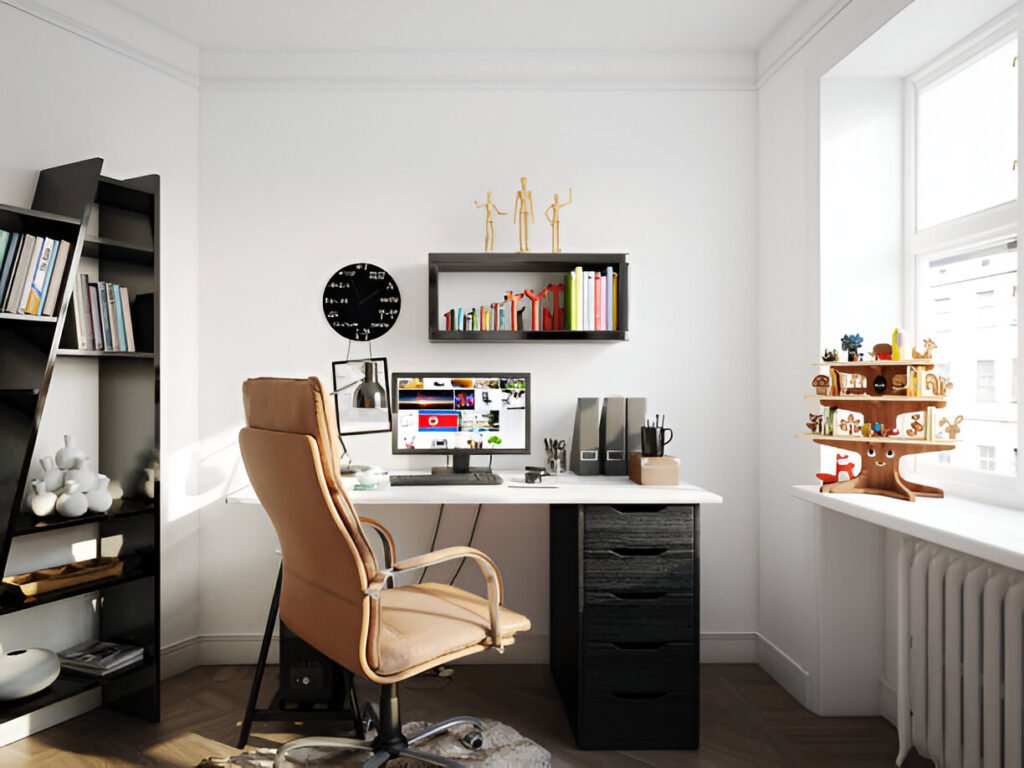
As of April 2025, roughly 34.3 million Americans are working from home, with a telework rate holding steady at 21.6%.
This sustained shift means your workspace now carries professional weight it never had before, including what appears behind you during video calls.
A well-chosen bookshelf organizes your documents while creating a professional backdrop that signals competence rather than improvisation.
This guide walks you through selecting modern home office bookshelves that actually work for knowledge workers, not just look good in product photos.
Key Takeaways:
- Modern bookshelves prioritize clean lines and functional design over ornate details
- Reach zones matter: place frequently used items 15-19 inches from your seated position
- Your work style (remote employee, student, content creator) determines shelf depth and configuration
- Wood dominates the market at 54.6% share, but metal and hybrid materials offer distinct advantages
- Small spaces require vertical thinking and modular solutions, not just smaller shelves
What Defines a Modern Home Office Bookshelf
Modern Design Principles Applied to Storage
Modern bookshelves share four defining characteristics:
- Clean lines that eliminate carved details and decorative moulding in favor of geometric simplicity
- Neutral palettes dominated by blacks, whites, greys, and natural wood tones that create visual calm
- Contrast accents used sparingly, such as walnut against white walls or black metal frames supporting light wood
- Open versus closed balance because too much open shelving creates chaos, while fully closed cabinets feel oppressive in small spaces
Function-First Design for Knowledge Work
Accessibility drives good bookshelf design. Items you grab multiple times daily should be placed in Zone 1, 15-19 inches horizontally from your seated position, roughly 5-8 inches above or below desk height.
Visibility matters because document searches drain cognitive energy. Cable management integration separates amateur setups from professional ones.
Modern bookshelves often include grommets or rear channels for routing power and Ethernet, keeping cords out of your video frame.
This approach to cable management reflects how your bookshelf functions as part of an integrated workspace system rather than as standalone furniture.
What Are the Best Bookshelf Types for Home Offices?
Open Shelving Units
For home office workers who need quick access to documents, open shelves offer visual lightness by allowing sightlines to pass through the space.
This transparency makes rooms feel larger, though only when you maintain consistent organization.
Ideal use cases include displaying curated book collections, holding frequently accessed binders, and creating that bookshelf-wealth video background.
These advantages come with trade-offs, particularly in dusty environments or when concealing certain items.
Books accumulate dust more quickly on open shelves, requiring weekly maintenance that closed storage eliminates.
The bigger challenge for remote workers appears during video calls: open shelving offers no way to hide clutter when meetings start unexpectedly.
Closed and Semi-Closed Bookshelves
Doors conceal chaos while maintaining clear sightlines during video calls. They eliminate the weekly dusting cycle while providing better conditions for archival storage, as documents stored behind doors are protected from light and air.
Semi-closed designs with glass doors balance these benefits with visibility. Reference books and decorative items remain protected from dust while staying visually accessible, making this configuration particularly effective for materials you need to locate quickly but don’t handle daily.
Modular and Adjustable Bookshelves
Scalability makes modular systems worth the initial complexity. Most users start with a three-shelf unit and add components as their collection grows, ensuring visual consistency with the original configuration.
Reconfiguration logic matters when you switch from a corporate employee to a freelancer or move to a smaller apartment.
Systems using standardized cubes or interchangeable components adapt to new spaces without forcing you to start over.
Wall-Mounted and Floating Shelves
In small home offices or bedroom workspaces where floor space comes at a premium, vertical optimization becomes the primary storage strategy.
Wall-mounted shelves free up floor space while pushing storage upward into underutilized zones. Weight limits require an honest assessment.
Drywall anchors typically support only 50 pounds, while studs can handle significantly more. Installation constraints multiply in rentals where you’re minimizing wall damage.
Floating shelves look sleek but require proper mounting to avoid slow-motion sag after six months of use.
How Do I Choose a Bookshelf for My Work Style?
Remote Workers
Document-heavy workflows demand different storage than students cramming for exams. If you’re handling client files or reports daily, depth matters more than height. Standard 12-inch depth doesn’t accommodate legal-sized documents lying flat.
A professional visual backdrop for video calls has become a legitimate selection criterion.
With 70% of job seekers now preferring hybrid work arrangements, your bookshelf is constantly on display in meetings, making a curated backdrop a functional requirement rather than a vanity concern.
Bookshelves positioned behind your desk create that intelligent backdrop without looking staged.
The most popular video conference background option remains the well-styled bookshelf.
Students
Textbook density creates unique challenges decorative shelves can’t handle. Accounting textbooks, medical references, and engineering manuals weigh substantially more than novels, requiring thicker shelves with proper support.
Budget and space constraints limit options for students in dorm rooms or shared apartments.
Adjustable shelving accommodates changing textbook heights from semester to semester.
Free-standing units perform better than wall-mounted options when you move annually between rentals.
Content Creators
Display versus storage trade-offs shape content creators’ needs. Your bookshelf becomes set dressing, requiring aesthetic curation while still holding equipment and props.
Lighting considerations matter because you’ll want shelves that accommodate ring lights or LED strips and avoid materials that create glare during filming.
Visual branding through shelf styling helps creators maintain consistent aesthetics across content.
Props and equipment sharing space with books require deeper shelves or hybrid units mixing open and closed storage.
What Materials Make a Bookshelf Look Modern?
Wood, Engineered Wood, and Veneers
Wood dominates home office furniture with a 54.6% market share for a good reason. Solid wood offers durability and refinishing options, but engineered wood provides stability at a lower cost.
Veneers deliver high-end aesthetics while using sustainable materials efficiently. Walnut brings warmth, oak offers versatility, and maple provides clean brightness.
Quality MDF with proper veneer lasts decades and resists warping better than some solid woods.
Metal Frames and Industrial Hybrids
Metal frames signal modern industrial design while providing exceptional strength-to-weight ratios—black powder-coated steel pairs with wood shelves for that Brooklyn-loft aesthetic without requiring Brooklyn-loft square footage.
Mixed material approaches work well in modern spaces, with metal providing structural support while wood surfaces maintain warmth.
Metal alone can feel cold, but combined with wood or concrete surfaces, it reads as intentionally modern rather than accidentally institutional.
Glass, Acrylic, and Mixed Materials
Glass shelving creates visual transparency that works in ultra-modern spaces. Tempered glass handles reasonable weight but shows every fingerprint.
Acrylic offers impact resistance and comes in various tints, though it scratches more easily.
Mixed-material designs that combine wood frames with glass shelves or metal structures with acrylic panels push boundaries while maintaining functionality. These materials work best for display rather than heavy-use storage.
How Do I Determine Bookshelf Size and Placement?
Small Home Offices and Bedrooms
When floor space is limited, vertical storage becomes your primary strategy rather than a secondary consideration. Tall, narrow bookshelves provide significant storage without consuming square footage.
Measure ceiling height before shopping. A 72-inch shelf provides maximum reach zone access, while an 84-inch unit pushes frequently accessed items beyond comfortable reach, requiring a step stool to access upper shelves.
Corner placements capture dead space that would otherwise go unused. Ladder-style shelves lean against walls, taking minimal floor space while providing adequate storage.
Shared or Multi-Use Spaces
Room divider configurations let bookshelves delineate workspace boundaries in open-concept apartments. Open-back designs maintain sightlines while providing storage on both sides.
Mobility matters because you’ll need to reposition units when converting your office back to a dining room. Consider units on casters that enable this flexibility.
Within these divider configurations, lower-profile shelves complement the boundary function by providing functional storage and visual separation without creating a segmented feel.
Dedicated Home Offices and Studios
Expansive wall systems become viable when you’ve got the square footage. Floor-to-ceiling built-ins maximize storage while creating architectural interest.
Custom solutions accommodate odd dimensions, electrical requirements, and specific storage needs.
Well-designed built-in options increase perceived home value, particularly in dedicated office spaces that prospective buyers will use similarly.
What Are Advanced Bookshelf Organization Techniques?
Zoning Shelves by Cognitive Function
The principle of cognitive zoning organises materials by how often you access them during work sessions. Reference materials you consult during work sessions should be kept at eye level in your neutral reach zone.
Archives and completed projects can be stored at higher or lower levels, since you’ll access them infrequently. Active project materials deserve prime real estate within easy reach.
Organizing your shelves this way reduces the mental friction of searching three shelves to find that one report when you’re already deep in focused work.
Vertical vs Horizontal Load Planning
Weight distribution affects shelf longevity more than most buyers realize. Place heavy items on lower shelves to reduce tipping risk.
Distribute weight evenly across the shelf width rather than clustering heavy books on one end. Horizontal load planning involves assessing the load each shelf bracket or support can handle and ensuring it remains well below that threshold.
Visual Weight Distribution and Eye-Line Control
What sits at eye level draws attention first. Place visually interesting items (colorful book spines, decorative objects, plants) at this prime height.
Upper shelves can handle more uniform or less interesting items since they’re viewed from below.
Lower shelves work for items you need to access but don’t need to showcase. This eye-line control helps maintain a professional backdrop without constant styling.
Comparison Table: Bookshelf Types vs Use Cases
| Shelf Type | Best For | Storage Capacity | Visual Impact | Space Efficiency |
| Open Shelving | Remote workers needing quick document access, content creators | Moderate; limited by visual clutter threshold | High; creates curated backdrop | Moderate; requires width for stability |
| Closed Cabinets | Professionals with confidential materials, minimalists | High; conceals clutter effectively | Low to moderate; depends on door design | High; hides depth efficiently |
| Modular Systems | Growing businesses, frequent movers, adaptable spaces | Scalable; expands with needs | Variable; depends on configuration | Excellent; adapts to available space |
| Wall-Mounted | Small spaces, apartments, minimalist setups | Low to moderate; weight-limited | High; floating appearance | Excellent; preserves floor space |
| Ladder Shelves | Temporary setups, renters, decorative storage | Low; primarily display-focused | High; architectural interest | Good; minimal footprint |
How Do I Style a Bookshelf Without Reducing Productivity?
Minimalist Styling Rules
When you’re staring at your bookshelf for 40 hours per week, reducing visual complexity helps prevent cognitive fatigue. Consider these principles:
- Odd-numbered groupings create more visual interest than solo items or even numbers because the human eye processes asymmetry as more dynamic and natural
- Empty space between groupings provides visual rest for your eyes during long work sessions rather than representing wasted real estate.
- Color blocking creates order without requiring obsessive arrangement
- Remove non-functional items because decorative clutter still drains attention even when it looks intentional
Functional Decor: When Objects Earn Their Place
Every item should justify its presence through beauty or utility, preferably both. That vintage typewriter looks excellent but it also holds pens. Plants purify air while adding life to your backdrop.
Awards and certifications serve a dual purpose: professional credibility during client calls and personal motivation during solo work.
Family photos belong in your personal space, not your professional background. Functional decor works because it integrates seamlessly into your workflow rather than existing solely for appearance.
Color, Negative Space, and Visual Rest
Monochromatic arrangements reduce cognitive load compared to rainbow-organized shelves.
Negative space between items prevents the crammed-bookstore aesthetic, which can read as chaotic on camera.
Group similar colors together rather than scattering them across shelves. White or neutral objects provide visual breathing room between darker book spines.
Balance warm and cool tones across your shelving unit rather than clustering all warm tones on one shelf.
Common Buying Mistakes to Avoid
1. Choosing Looks Over Load Capacity
That gorgeous glass shelf won’t support your law school textbook collection. Check actual weight ratings, not aspirational ones from marketing copy.
Engineered wood shelves should be at least 0.75 inches thick for books; 0.5 inches is too thin and will sag over time. Metal brackets matter more than shelf material because cheap brackets fail before quality shelves do.
2. Ignoring Depth, Not Just Height and Width
Standard books require 8-10 inches of depth, but textbooks, binders, and decorative items need 12-15 inches.
Measure your largest books before buying to avoid frustrating diagonal placement or items jutting beyond shelf edges. Depth affects visual weight.
Deeper shelves appear more substantial but consume more room space. Wall clearance matters when shelves have backs; allow 2-3 inches behind the unit for baseboards and uneven walls.
3. Overdecorating and Reducing Usable Storage
Styling kills storage faster than anything else. Those Pinterest-perfect bookshelves with one book per two feet of shelf space look amazing in photos, but provide minimal functional storage. Balance decoration with utility by maintaining 60-70% storage and 30-40% styling.
Rotate decorative items seasonally to keep your background fresh without sacrificing permanent space. Remember that empty shelf space costs money if you end up buying a second bookshelf because the first is too styled to hold books.
Summary: How to Select a Bookshelf That Actually Works
- Match shelf type to work behavior: Remote workers prioritizing video backgrounds need open shelving at desk height, while students need closed storage for textbook density
- Prioritize modularity and vertical space: Expandable systems adapt to changing needs; tall units maximize storage in constrained floor space.
- Treat style as a constraint, not the goal: Modern aesthetics should enhance function, not replace it; clean lines and neutral palettes age better than trendy finishes
- Buy for future workflow, not current clutter: Anticipate growth in collections, job changes, and space transitions when selecting permanent furniture.
- Consider ergonomics seriously: Zone placement based on reach distance and frequency of use prevents strain and improves efficiency during long workdays.
Frequently Asked Questions on Modern Home Office Bookshelves
What is the best bookshelf for a modern home office?
The best bookshelf matches your specific workflow and space constraints.
Remote workers benefit most from open shelving units 60-72 inches tall, positioned directly behind their desks as video call backgrounds.
Wood construction with metal accents strikes the right balance between durability and modern aesthetics.
Adjustable shelves accommodate changing storage needs as your career evolves.
Budget matters because quality engineered wood at $200-400 outperforms cheap solid wood at the same price point.
Are open or closed bookshelves better for a home office?
Open bookshelves are better for remote workers who need quick access to documents and professional video backgrounds, while closed shelving suits professionals handling confidential materials or those who struggle with visual clutter.
Semi-closed designs with glass doors offer compromise: dust protection with visibility. The bookshelf wealth trend emphasizes curated open displays, but this only works if you’ve got time for regular organization.
Your dust tolerance matters more than design blogs acknowledge; open shelves in dusty climates require weekly maintenance, whereas closed storage eliminates the need for it.
How tall should a bookshelf be for a home office?
The ideal height is 72 inches because it maximizes storage without requiring a step stool for daily access.
Ergonomic reach zones suggest that frequently used items should be kept between 30 and 60 inches above the floor when seated.
Anything over 72 inches falls into extended-reach zones, where you’ll need to stand to access items safely, particularly for heavier books or binders.
Ceiling height limits your options; measure before shopping to avoid that awkward three-inch gap or worse, a shelf that doesn’t fit.
Can bookshelves be used as room dividers in a home office?
Bookshelves make excellent room dividers in shared or multi-use spaces, particularly open-back designs that provide storage on both sides while maintaining sightlines.
Units between 60 and 72 inches tall define space boundaries without creating a solid wall that visually reduces the room.
Freestanding bookshelves offer flexibility in apartments or rental situations where you can’t install permanent dividers.
The key is ensuring the unit is stable enough to remain upright without wall anchoring. Wider bases and lower centres of gravity prevent tipping when accessed from either side.
How to decorate home office bookshelves without making my office look cluttered?
Maintain the 60-40 rule: 60% functional storage, 40% decorative elements—group items in clusters of three to maintain visual appeal without clutter.
Leave intentional negative space between groupings; empty shelf space creates visual rest. Use uniform bookends or storage boxes to contain smaller items and create clean lines.
Color blocking by grouping similar tones together reduces visual noise. Rotate decorative items seasonally rather than cramming everything onto shelves simultaneously.
Remember, your bookshelf appears in video calls; what looks good in person might read as cluttered on camera.